01
The information was there.
Useful material lived across videos, channels, search engines, metadata and source pages—but the research workflow was fragmented across too many tabs and too many tools.
Follow signals.
Keep custody of your research.
SignalGlass is a local-first research console built for journalists, investigators, researchers and curious minds who need to move through public information without losing context, sources or control of the workflow.
Useful material lived across videos, channels, search engines, metadata and source pages—but the research workflow was fragmented across too many tabs and too many tools.
We wanted one place to search deeply, inspect what we found, organize sources, revisit previous work and move immediately from discovery to examination.
yt-dlp became the lens into channels and video metadata. SearXNG opened the wider web. Collections created continuity. mpv made playback immediate.
Not another feed. Not another hosted workspace. A focused, operator-controlled console for following public signals through noise.
Examine recent uploads or search deeply within a creator's publication history.
Resolve titles, dates, channels, view counts and canonical source URLs for faster examination.
Use SearXNG to pivot beyond one platform into broader web, image and source discovery.
Group channels and sources around investigations instead of rebuilding context every session.
Preserve a local record of previous research activity and results for continuity across sessions.
Send discovered video directly to mpv without forcing the research workflow back into a platform interface.
SignalGlass began as a working research tool before it had a name. The interface follows the investigation: search, narrow, inspect, organize and open the source.
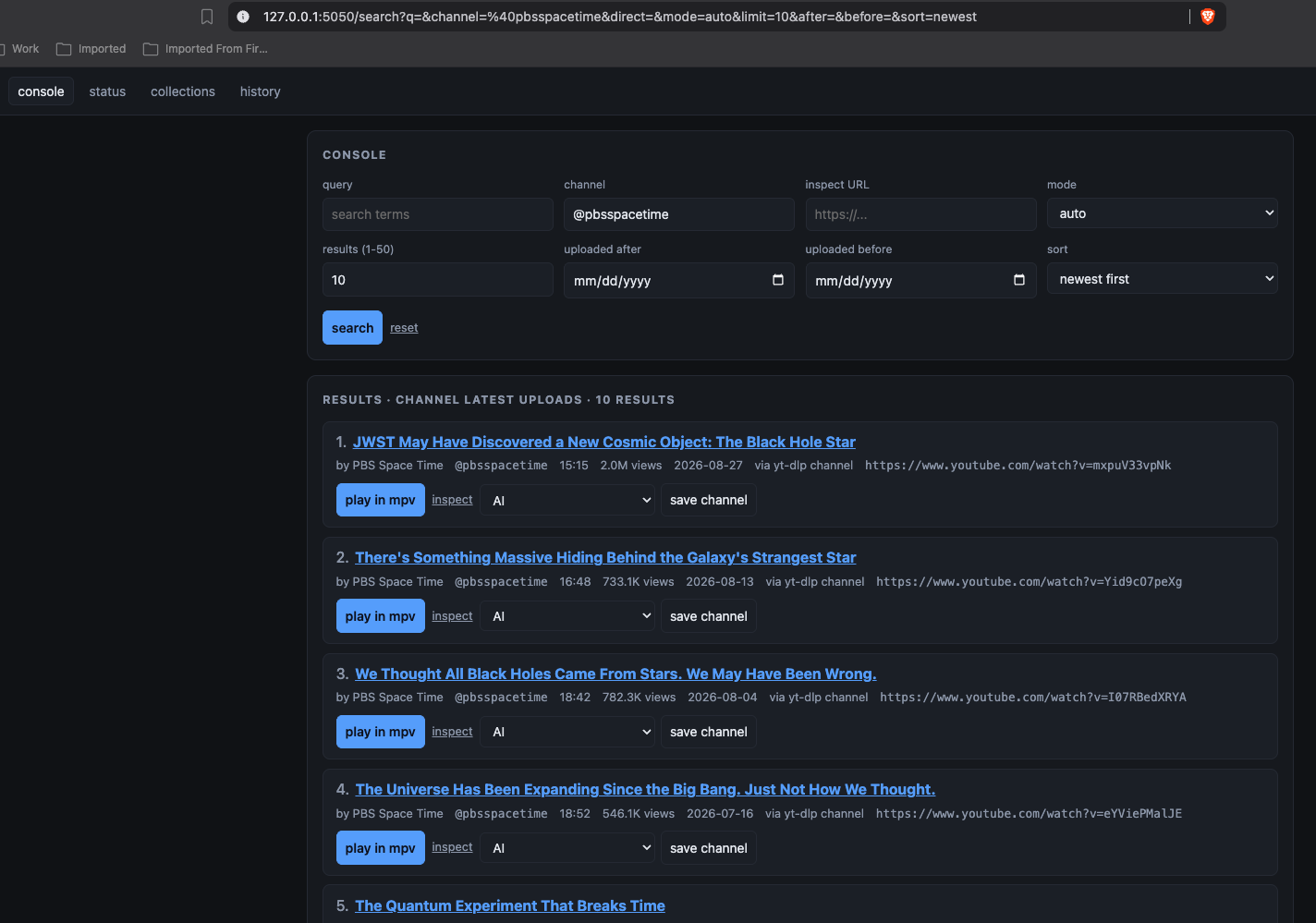
SignalGlass is designed around an application running on the researcher's own machine, not a mandatory hosted workspace.
The goal is not to manufacture answers. It is to help the operator find, inspect and move between public sources efficiently.
Proven command-line tools remain useful underneath the interface rather than being hidden behind an opaque proprietary stack.
Search and automation reduce friction. They do not replace source evaluation, verification or editorial judgment.
SignalGlass is being built as a practical research instrument: discover the source, examine the context, preserve the path, and keep the operator in control.